












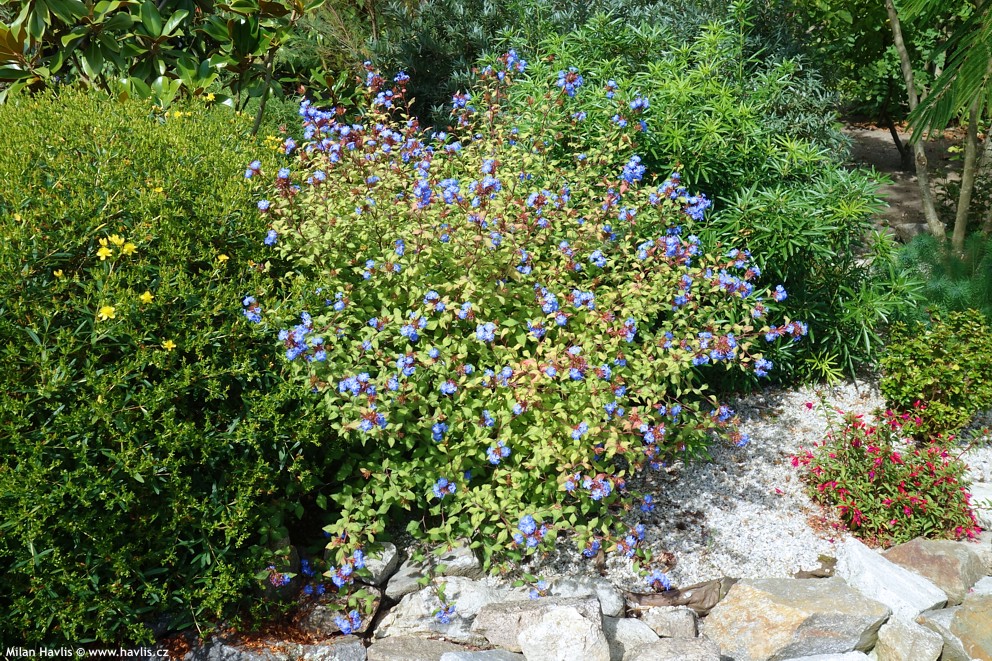
Ceratostigma willmottianum Willmott's leadwort, hardy plumbago

 Symbivit Tric (arbuscular)
 Symbivit (arbuscular)
Ceratostigma
The genus Ceratostigma, commonly known as leadwort or hardy plumbago, belongs to the Plumbaginaceae family and comprises just seven accepted species distributed from eastern Africa through the Himalayas to China and Indochina. The genus was established and scientifically described by Alexander von Bunge (1803�1890), a Russian-German botanist who collected numerous plants previously unknown to European science during his expedition to northern China. The name Ceratostigma itself is derived from the Greek words for horn and stigma, referring to the tiny horn-like projections found on the stigmas of the flowers and visible only upon close inspection. While the origin of the common name leadwort remains debated, one theory links it to the grey-blue colour of lead, while another traces it to traditional medicinal uses of plants in the related genus Plumbago, which were once recommended for ailments associated with the then-common effects of lead poisoning. Despite its modest size, the genus includes a remarkably diverse range of plants, from ground-covering perennials to mountain subshrubs inhabiting rocky slopes, woodland edges and alpine valleys across Asia.
The species Ceratostigma willmottianum was described by Otto Stapf (1857�1933) in 1914 from plants originating in the mountains of western China and south-eastern Tibet. It was first collected as seed by Ernest H. Wilson and named in honour of Ellen Ann Willmott (1858�1934), one of the most influential British horticulturists of the late nineteenth and early twentieth centuries, renowned not only for her remarkable gardens but also for financing botanical expeditions and supporting many of the great plant hunters of her day. Unlike Ceratostigma plumbaginoides from northern and eastern China, this species comes from far harsher mountain regions, where intense alpine sunshine, cold nights and dramatic temperature fluctuations may all occur within a single day. It is precisely this rugged mountain heritage that has made it exceptionally well suited to cultivation in temperate climates. The species reached European gardens during the golden age of plant hunting, when names such as Ernest H. Wilson (1876�1930), George Forrest (1873�1932) and Frank Kingdon-Ward (1885�1958) were regularly introducing new plants from previously little-explored parts of Asia. Ceratostigma willmottianum attracted attention not only because of its origin but also because it expanded the small genus Ceratostigma with a completely different type of plant from the ground-covering C. plumbaginoides, which had already been known to European horticulture for almost eighty years.
Incidentally, did you know that blue was among the rarest and most prized colours throughout much of human history? While red, yellow and brown pigments could be obtained almost everywhere, producing a rich and lasting blue was considerably more difficult. Among the most valuable sources were indigo dyes extracted from plants and the precious stone lapis lazuli imported from what is now Afghanistan. The high cost of blue pigments meant that blue garments, textiles and decorative features served for centuries as symbols of wealth and status. In medieval Europe the colour gained further prestige through depictions of the Virgin Mary wearing a blue cloak, and its popularity was strengthened by King Louis IX (1214�1270) of France, who adopted it among the symbols of royal authority. Only towards the end of the nineteenth century was the chemical nature of indigo fully understood and industrial production established, gradually transforming blue from a luxury commodity into an everyday colour.
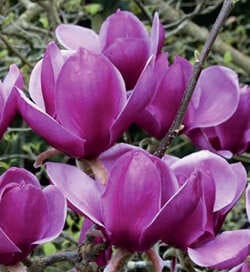
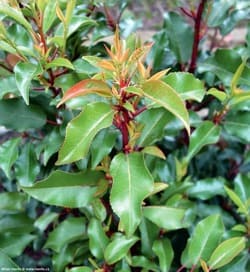
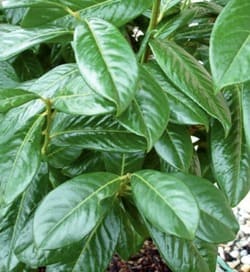
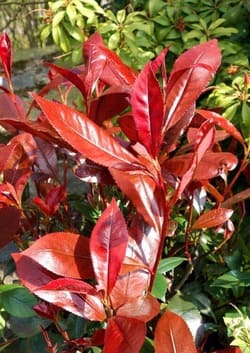
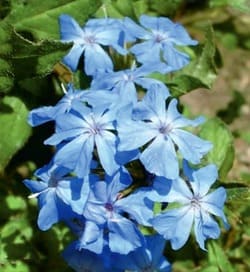
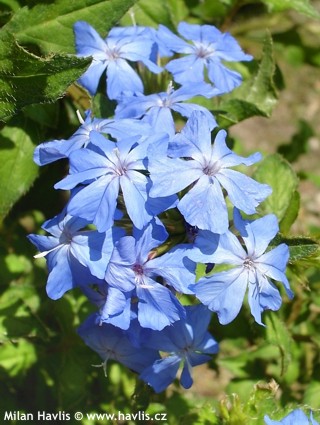
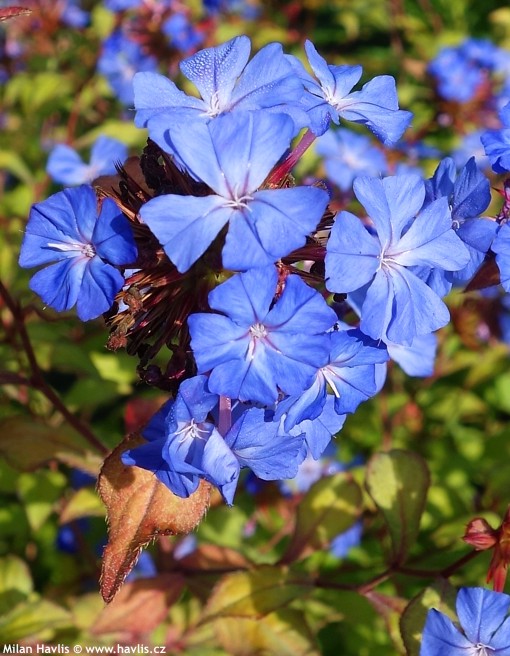
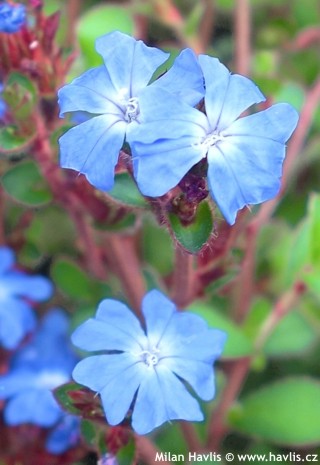
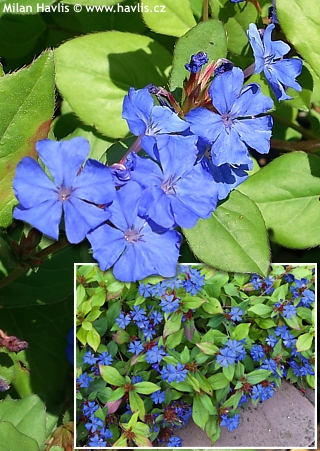
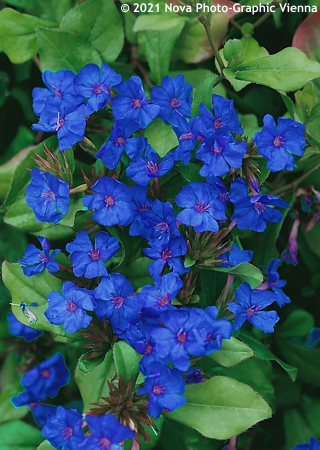
Most gardeners know the familiar Mediterranean plumbago, a shrub with sky-blue flowers and fresh green foliage that colours countless coastal towns and holiday destinations throughout southern Europe. Fortunately, a closely related species of remarkably similar appearance can bring much the same charm to far harsher climates � Willmott's leadwort. It is recognised by its sky-blue flowers, which begin to appear from mid-August onwards. Each of the five petals is marked by a pronounced central vein, giving the impression that the petal has been carefully folded in half and opened again, much like a sheet of paper that still bears the crease of an earlier fold. Unlike the ground-covering Ceratostigma plumbaginoides, it has the appearance of a small shrub and is botanically regarded as a subshrub or woody perennial. In spring, slender reddish shoots emerge from the ground, often with a noticeably irregular, zigzagging habit, carrying alternate, deciduous, narrowly ovate to diamond-shaped leaves. These are softly hairy and provide a calm green backdrop through most of the growing season before gradually turning muted shades of purple and burgundy as autumn approaches. Even then the plant continues flowering, creating the unusual spectacle of red foliage and blue flowers at the same time, with the intensity of the flower colour deepening as temperatures begin to fall. This ability to combine blue and red in a single moment is one of the main reasons why Willmott's leadwort has remained a valued feature of European gardens for more than a century.
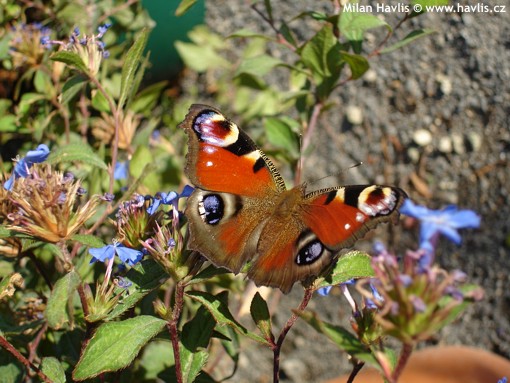
Willmott's leadwort deserves light, sunny and airy plantings where its unique flower colour can take centre stage. It combines beautifully with yellow threadleaf coreopsis and orange or pink agastache. Purple and blue scabious provide colour long before it comes into bloom, while lower-growing coneflowers in rich warm shades add drama and contrast. Dark-leaved stonecrops bring depth to the composition, while the silvery foliage of curry plant, cotton lavender or wormwood offers the eye a welcome resting place and further emphasises the purity of the blue flowers. For greater colour diversity and an exceptionally long flowering season, I planted ground-covering Canadian vervain as a border beneath it. Its soft pink and lilac flowers light up the entire planting without drawing attention away from the principal performers. It also looks perfectly at home among creeping herbs and aromatic subshrubs, where its green foliage blends quietly into the background for most of the year before transforming into an unexpected fireworks display of blue flowers in late summer. If you would like to recreate a Mediterranean atmosphere, combine it with hardy cultivars of agapanthus in white or blue tones and place Mexican orange blossom or a floribunda standard rose with small flowers in the background.
Last update: 18-09-2008; 13-09-2026
Willmott's leadwort requires full sun, ideally all day long, and well-drained soil that does not retain excess moisture, especially during the winter months. It originates from the mountains of western China and Tibet, where severe frosts are common, but water drains rapidly through rocky slopes. For this reason, winter wet is far more likely to cause problems than cold itself. In spring, all the previous year's shoots should be cut back to ground level. Although the plant develops a woody base, most of the above-ground growth usually dies back during winter in temperate climates, with fresh shoots emerging from the root system the following spring. Fertilising should be minimal or omitted altogether, as overly rich soils encourage vigorous growth at the expense of flowering and reduce the intensity of autumn foliage colour. Thanks to its more compact root system, it is better suited to container cultivation than the ground-covering Ceratostigma plumbaginoides, although containers must provide perfect drainage and should be moved to a frost-free place for winter. The plant is generally free from serious pests and diseases, is not known to be poisonous, and in well-drained soil will typically tolerate temperatures down to approximately -24 �C (USDA zone 6) without winter protection, or with nothing more than a bark mulch to reduce rapid soil freezing and minimise temperature fluctuations around the roots.

Goods are shipped all over Europe. For Russia and U.K. and for further details please read about SHIPPING OPTIONS HERE.
Are you interested in a serious discount for orders NOV-FEB? Check your options here.
THE PRICES INCLUDE VAT of 15%. For quick conversion you can use 1 CZK = approx. 0.04 EUR
- STANDARD QUALITY - Plants of this group are 1st class quality with number of branches and overall density adequate to their size and age, considering they were container grown.
- DE LUXE QUALITY - This label guarantees a luxurious quality of manually selected plants that, compared to their height and age, are exceptionally dense and beautiful.
- EXTRA - These plants are usually mature and bigger specimens with exceptional overall appearance.
- STANDARD (as described in the plant form) means a tree with a trunk of 190-210 cm and a crown at the top, unless specified differently. The commercial size for trees is their girth measured in the height of 1m from ground.
- HOBBY - These plants are of the same quality as our standard-quality plants but younger and therefore cheaper.
- SHRUB - a woody plant with branches growing bushy from the ground level.
- HALF-STANDARD or MINI-STANDARD - a small tree with shorter trunk, its size is usually specified.
- FEATHERED - These are trees with branches growing already from the base of the trunk and up along the stem.
- GRASSES and PERENNIALS - Sizes given usually read the diameter of the pot or the clump, as specified.
