












Ilex crenata 'Caroline Upright' DARK STAR Japanese holly, box-leaved holly

 Symbivit Tric (arbuscular)
 Symbivit (arbuscular)
Ilex
The genus Ilex, known as holly, comprises more than four hundred species of evergreen and deciduous shrubs and trees distributed across much of the world, with centres of diversity in the subtropics and the mountainous regions of East Asia and the Americas. Botanically, the genus is characterised by leathery leaves, often with pronounced venation, inconspicuous flowers and striking fruits � drupes that are typically red, less commonly black or yellow. Most hollies are dioecious, meaning that male and female flowers occur on separate plants and fruit production requires the presence of both sexes. The genus was described by Carl Linnaeus (1707�1778), though its taxonomy continues to evolve due to high morphological variability, frequent hybridisation and the wide ecological range of individual species. Fossil and molecular evidence suggests that the main lineages of Ilex originated in the Eocene, indicating long-term stability and an ability to adapt to changing climatic conditions.
Hollies have accompanied humans for millennia not only as useful and ornamental plants but also as powerful cultural symbols. In Europe, Ilex aquifolium is traditionally associated with the winter solstice, Christmas and the idea of protecting the home from evil forces, while in North America Ilex opaca was valued for its hard timber and medicinal properties. In East Asia, particularly in Japan, hollies found their place in garden art as plants expressing permanence, order and the ability to withstand adversity � values deeply rooted in local aesthetics. In modern landscape design, the genus Ilex has become a symbol of structure and endurance, whether in the form of formal hedges, shaped specimens or calm evergreen backdrops that persist even in winter.
Ilex crenata, Japanese holly, originates from Japan, Korea and eastern China, where it grows in mountain forests on acidic soils. It was first described by Carl Peter Thunberg (1743�1828), a Swedish botanist working in Nagasaki, who was one of the few Europeans of the 18th century to gain direct access to Japanese flora during the country�s strict isolation. It differs from other species of the genus by its small, glossy, spineless leaves, compact growth and ability to tolerate hard pruning, so many people mistake it at first glance for boxwood or even certain Lonicera species. This resemblance predestined it to become an ideal replacement for true boxwood, which has been steadily disappearing across Europe under the pressure of the massive invasion of the box tree moth and fungal diseases, especially box blight, which has devastated plantings on the British Isles. Japanese hollies are spineless, offer a wide range of shapes and sizes, require only minimal care and, thanks to their natural variability, frequently produce new cultivars, each slightly different from the last. In this way, Ilex crenata has evolved from a botanical curiosity into a key plant of contemporary garden design, capable of taking over the role of a historically rooted element of formal gardens, cemeteries and urban parterres without the need for chemical protection.
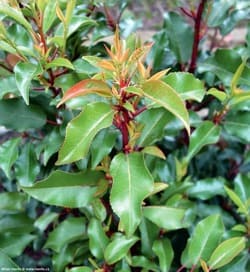
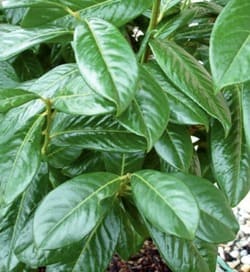
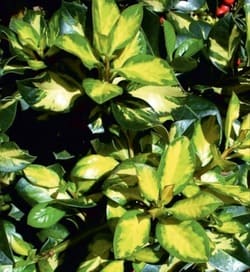
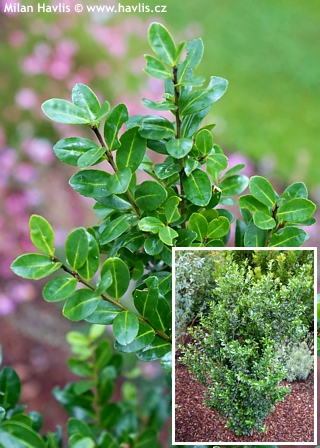
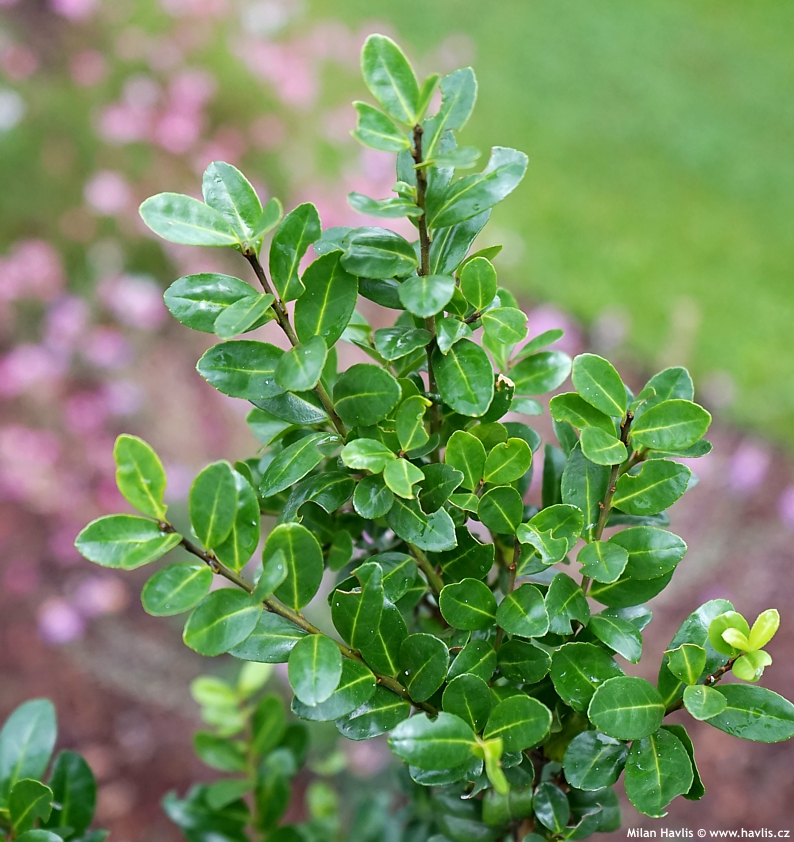
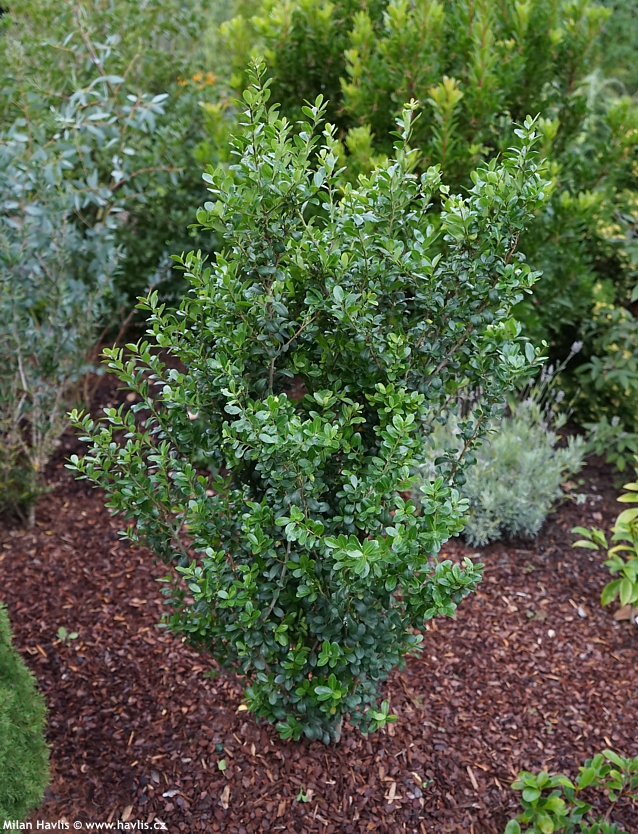
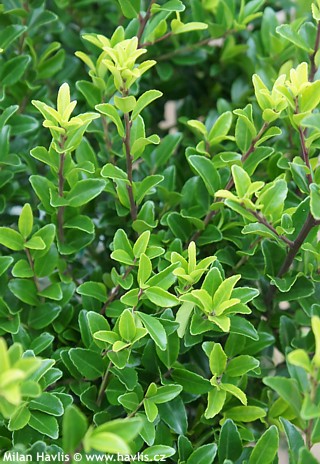
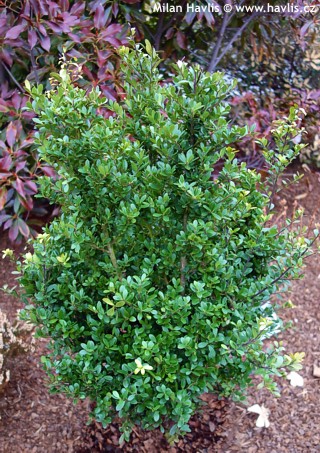
Caroline Upright or DARK STAR is a selection of Japanese holly with upright growth and deep green leaves. They are broadly elliptic. In mid spring opens a profusion of small, creamy white flowers serving plenty of bee food. It is a female variety so if pollinated by a male plant from nearby they are followed by small, black berries in autumn. They are not edible nor poisonous for people but contain saponins which cause severe discomfort if eaten in quantity. They are important bird food in winter. Stems are pale grey-green.
It grows about 20-30 cm per year and naturally forms dense, upright growing, many-branched shrubs. You can use it like a box plant - in the same spot or a container or among other large-leaved, evergreen plants to which its delicate foliage will provide a great contrast. As every other Japanese holly it is ideal for bonsai making as well as for hedging. It can be pruned and clipped in almost any way from early spring by end July.
Last update: 09-09-2022
Japanese holly is tolerant of most soil types except heavy clay, but it thrives best in well‑drained, evenly moist, acidic soil, occasionally enriched with slow‑release fertilizer. It has a strong root system that copes better with poorer conditions than English hollies and adapts easily to the limited root space of containers without showing signs of stress or drought. It grows well in full sun and partial shade, and it will cope even with shaded positions; in deeper shade the habit may be a little looser, but it still performs surprisingly well. Japanese holly is an excellent shrub for shaping. A spring trim after the last frosts encourages fuller branching, and a light mid‑summer trim is purely for maintaining form. It is hardy to about −27 �C (USDA zone 5) and is also suitable for outdoor planters with good drainage and where it requires more frequent but careful watering, including during frost‑free winter days.

Goods are shipped all over Europe. For Russia and U.K. and for further details please read about SHIPPING OPTIONS HERE.
Are you interested in a serious discount for orders NOV-FEB? Check your options here.
THE PRICES INCLUDE VAT of 15%. For quick conversion you can use 1 CZK = approx. 0.04 EUR
- STANDARD QUALITY - Plants of this group are 1st class quality with number of branches and overall density adequate to their size and age, considering they were container grown.
- DE LUXE QUALITY - This label guarantees a luxurious quality of manually selected plants that, compared to their height and age, are exceptionally dense and beautiful.
- EXTRA - These plants are usually mature and bigger specimens with exceptional overall appearance.
- STANDARD (as described in the plant form) means a tree with a trunk of 190-210 cm and a crown at the top, unless specified differently. The commercial size for trees is their girth measured in the height of 1m from ground.
- HOBBY - These plants are of the same quality as our standard-quality plants but younger and therefore cheaper.
- SHRUB - a woody plant with branches growing bushy from the ground level.
- HALF-STANDARD or MINI-STANDARD - a small tree with shorter trunk, its size is usually specified.
- FEATHERED - These are trees with branches growing already from the base of the trunk and up along the stem.
- GRASSES and PERENNIALS - Sizes given usually read the diameter of the pot or the clump, as specified.
