












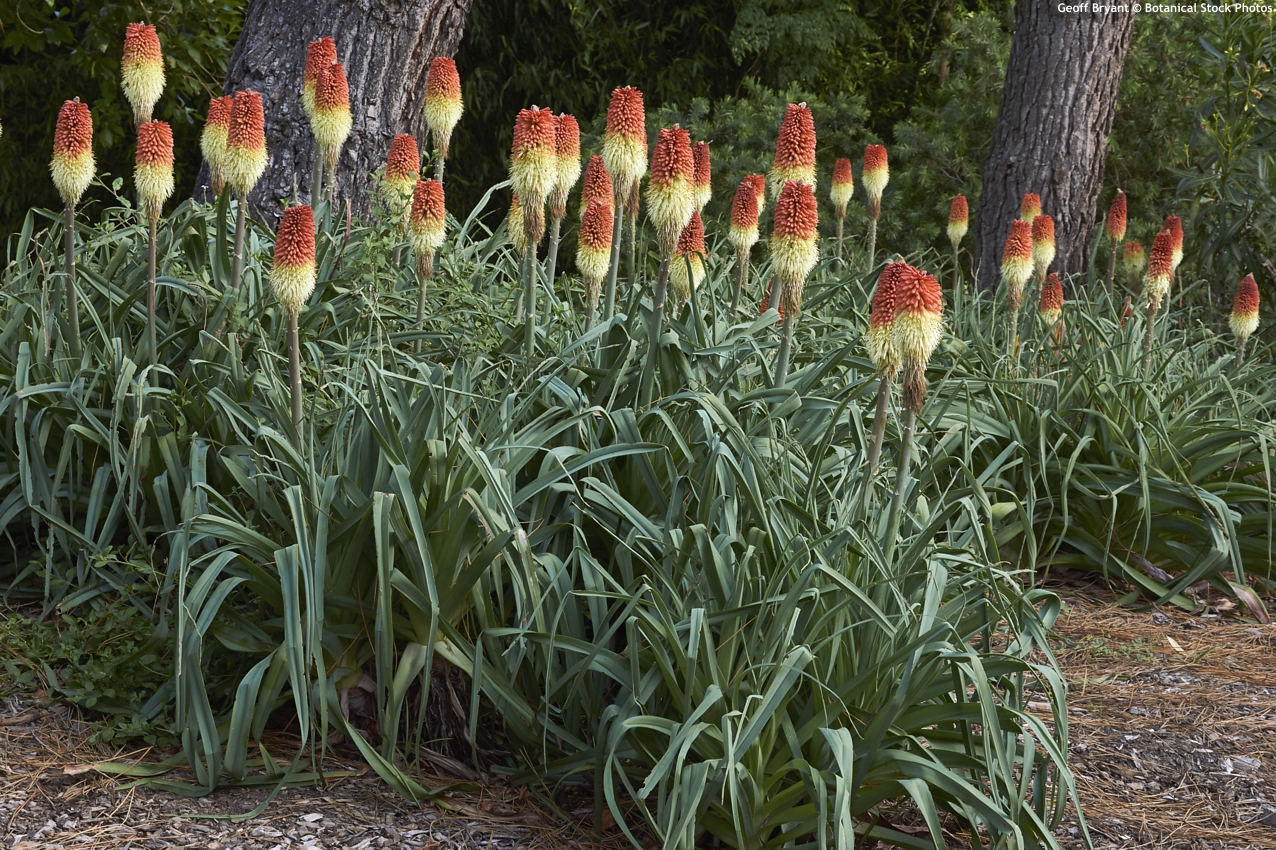
Kniphofia caulescens torch lily, red hot poker


 Symbivit Tric (arbuscular)
 Symbivit (arbuscular)
Kniphofia
The story of the genus Kniphofia began long before people realised that the grassy mountains of southern and eastern Africa hide unexpected treasures. The name was first used by the German botanist Conrad Moench in 1794, when he separated the then‑known �tritomas� from Aletris and Veltheimia and dedicated the group to his compatriot Johann Hieronymus Kniphof (1704�1763). The modern, accepted circumscription of the genus, however, comes from Lorenz Oken, who redefined Kniphofia in 1841; his concept is the one used today. Today we know that the genus comprises roughly 70�73 species, all native to Africa, with a single exception in Yemen and a few species on Madagascar. Their home lies mainly in the higher and cooler regions of eastern and southern Africa, where individual species often grow on isolated mountain ridges. This fragmented landscape caused kniphofias to diversify rapidly over time, and some species are so close to one another that botanists still struggle to draw clear boundaries. This history, shaped by glacial cycles, secondary contacts and repeated isolation, explains the taxonomic complexity of the genus, which botanists such as Syd Ramdhani, Nigel P. Barker and Himansu Baijnath have described as a �recent afromontane radiation�. Do you understand any of that? Do not worry � I am not entirely sure they do either 😊 Kniphofias are, in any case, a story of long evolution whose intricate branches are still being unravelled.
Kniphofia caulescens comes from the high-altitude regions of the Eastern Cape, KwaZulu-Natal and Lesotho, where it grows in a cool, moist climate with frequent mist, rich soils and a steady supply of water. In its native habitat it occupies wet to waterlogged grasslands and the edges of calm streams, so it is adapted to nutrient-rich soils and consistent moisture. At home it is permanently evergreen and forms a distinctly woody base reminiscent of a yucca. It spreads slowly by rhizomes, and in warmer areas also by seed. The species was described by John Gilbert Baker (1834�1920) in 1872 in the Botanical Magazine, making it one of the classic, well-documented kniphofias of the nineteenth century.
The English common name of Kniphofia has travelled a surprisingly lively path. The earliest name, �red-hot poker�, appeared in the 19th century and captured the plant�s dramatic flower spikes that look as if someone had plunged a glowing iron into the border. Soon after came �torch lily�, a gentler and more botanical term that emphasised the torch-like inflorescences while hinting at the plant�s place among monocots. In some regions �tritoma� survived well into the 20th century, inherited from older botanical classifications before Moench separated the genus. Today �red-hot poker� remains the most widespread name, partly because it conveys the plant�s character in a single glance, while �torch lily� persists in more formal horticultural writing.
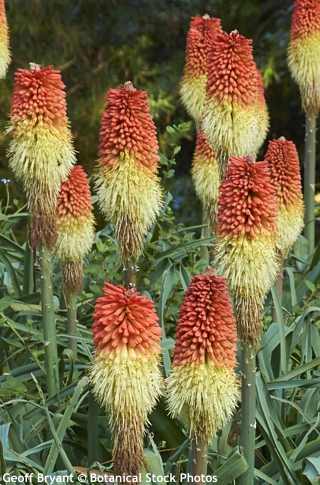
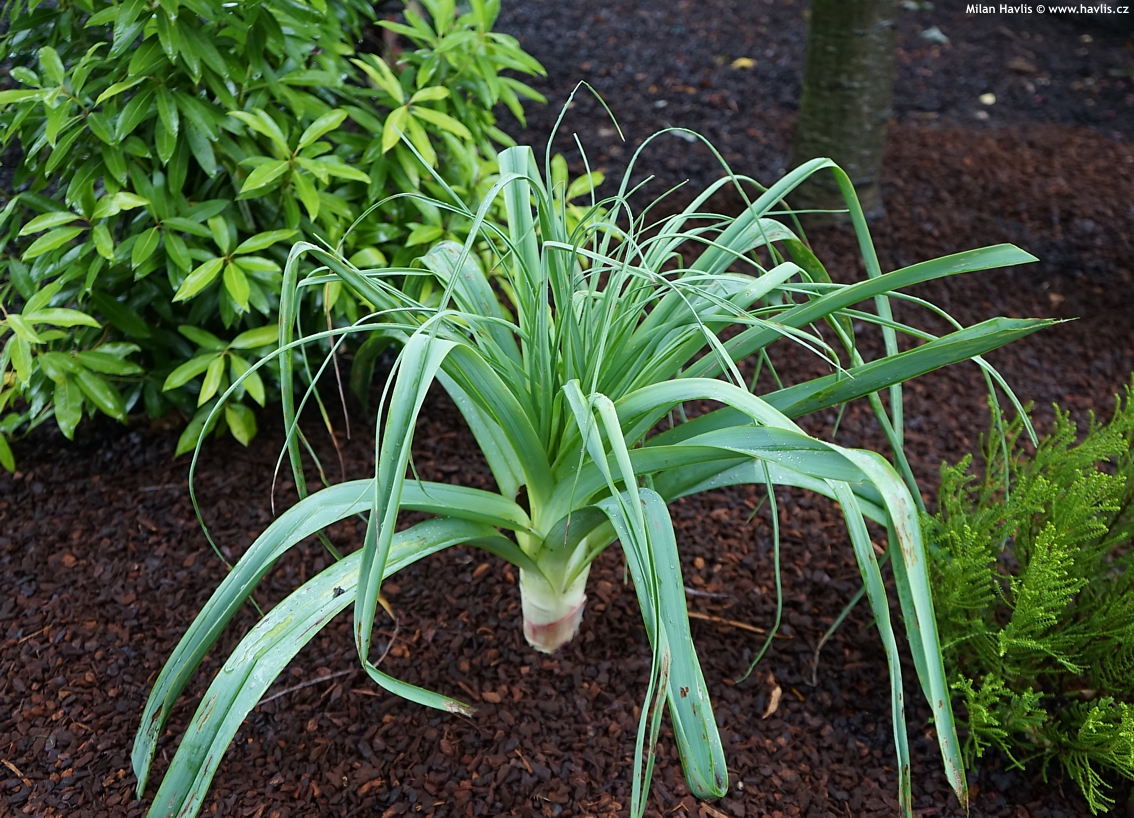
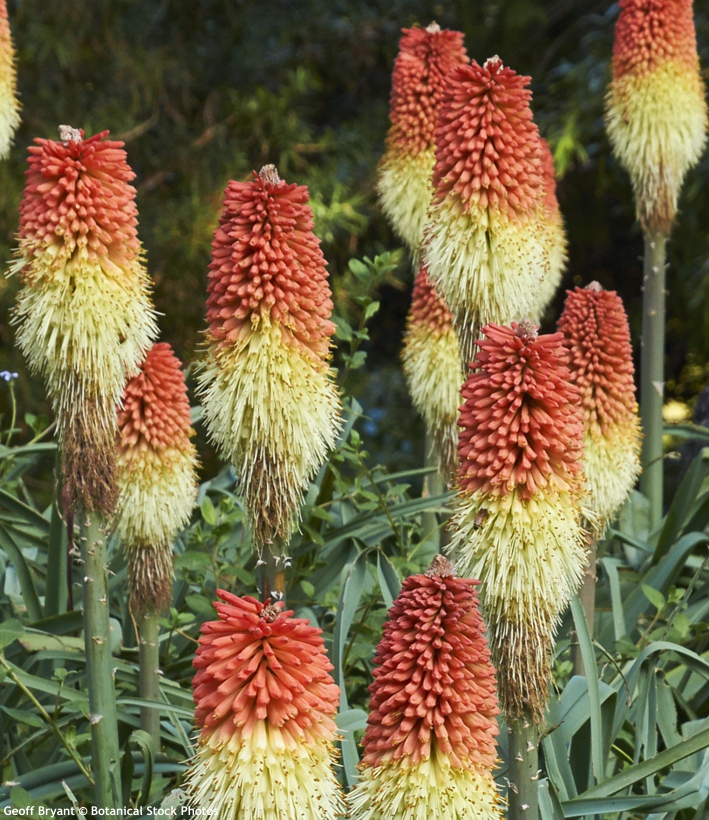
Kniphofia caulescens is an exceptional species that cannot be mistaken for anything else. Its stem is so thick that it has earned the nickname �the leek�, and it really does look as if it could be sliced into a soup (please don�t eat it 😊). It grows up to one metre tall, and at its tip, in mid to late summer, appear massive, spike-like inflorescences composed of narrow tubular flowers in two strongly contrasting colours � the unopened buds from the top down to about halfway are warm scarlet red, while the lower, open flowers are lemon yellow. They open from the bottom upwards and reveal fine stamens with anthers, giving the open flowers a bearded appearance.
The leaves are another unmistakable feature: 5�7 cm wide, 50-70 cm long, light blue‑green and bent downwards at the tips, as if they could not be bothered to hold their shape. In areas with mild winters, it is enough to carefully remove the old basal leaves in spring, as new ones emerge from the centre. In colder regions it is advisable to tie the leaves into a bundle before winter, just as you would with ornamental grasses; if frost damages them, they can be safely cut back to about 10 cm in early spring without harming the leaf crown.
Thanks to its large leaves and bold, imposing flowers, Kniphofia caulescens is used in exotic-style gardens and everywhere you want to create striking summer flowering borders. Its unique appearance requires a bit of thought when composing a planting � it will not look good lost among perennials with thin stems and a loose, inconsistent habit. Choose neighbours that are clearly different, such as mounded herbs � thymes and mother-of-thyme; it pairs beautifully with fine‑leaved evergreen shrubs such as Mexican orange blossom or abelia. Its blue‑green foliage works well with silvery and grey structures that highlight both the �leek-like� stem and the two‑tone flowers: for example perovskia, lavender, santolina, helichrysum or low-growing artemisias. If you want a planting with strong contrast, place it next to dark‑leaved barberries, variegated heucheras or dark‑leaved bugbanes, which bring out its pale blue‑green habit. And for a really clean, modern composition, plant it in a gravel bed with a few well‑chosen stones, where it will look like a plant that has brought a piece of Lesotho straight into a Central European garden.
Last update 30-08-2020; 09-07-2026
Kniphofia caulescens needs full sun and fertile, evenly moist but well-drained soil. In nature it grows in wet meadows, but in gardens it dislikes winter wet, so heavy clay is a problem. In mild winters, simply remove the old basal leaves in spring, as new ones emerge from the centre. In colder regions it is advisable to tie the leaves into a bundle before winter; if frost damages them, they can be safely cut back to about 10 cm in early spring without harming the leaf crown. Hardiness is around �25 �C (zone 6), but in areas with long winters a light mulch over the roots is helpful. The plant spreads slowly by rhizomes, and in warmer areas also by seed. After flowering it is best to remove the spent flower stems so the plant does not waste energy producing seed.

.jpg)
Goods are shipped all over Europe. For Russia and U.K. and for further details please read about SHIPPING OPTIONS HERE.
Are you interested in a serious discount for orders NOV-FEB? Check your options here.
THE PRICES INCLUDE VAT of 15%. For quick conversion you can use 1 CZK = approx. 0.04 EUR
- STANDARD QUALITY - Plants of this group are 1st class quality with number of branches and overall density adequate to their size and age, considering they were container grown.
- DE LUXE QUALITY - This label guarantees a luxurious quality of manually selected plants that, compared to their height and age, are exceptionally dense and beautiful.
- EXTRA - These plants are usually mature and bigger specimens with exceptional overall appearance.
- STANDARD (as described in the plant form) means a tree with a trunk of 190-210 cm and a crown at the top, unless specified differently. The commercial size for trees is their girth measured in the height of 1m from ground.
- HOBBY - These plants are of the same quality as our standard-quality plants but younger and therefore cheaper.
- SHRUB - a woody plant with branches growing bushy from the ground level.
- HALF-STANDARD or MINI-STANDARD - a small tree with shorter trunk, its size is usually specified.
- FEATHERED - These are trees with branches growing already from the base of the trunk and up along the stem.
- GRASSES and PERENNIALS - Sizes given usually read the diameter of the pot or the clump, as specified.
