












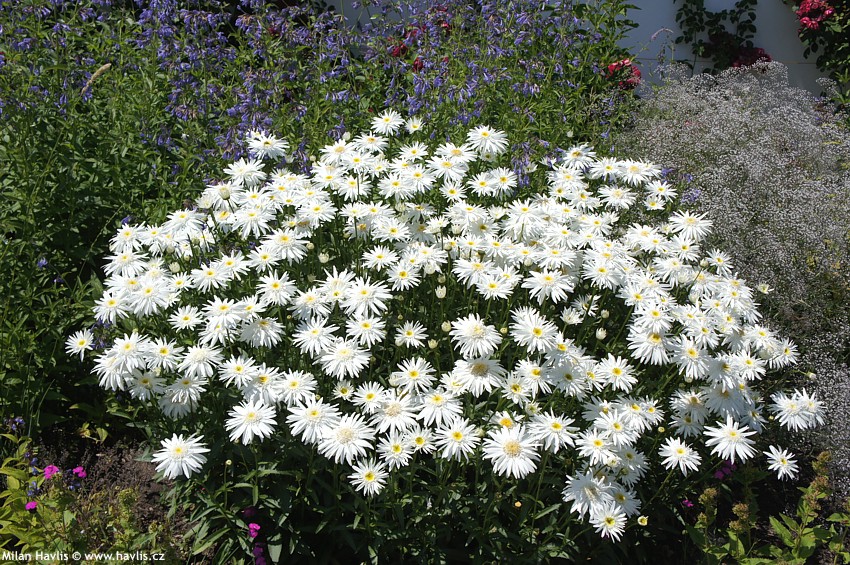
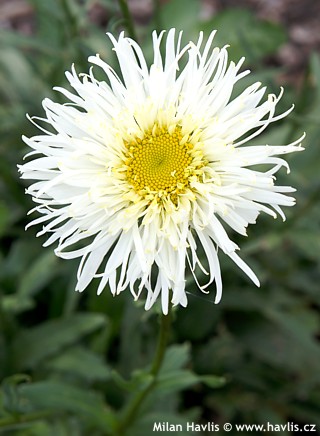
Leucanthemum 'WIRRAL SUPREME' Shasta daisy

 Symbivit Tric (arbuscular)
 Symbivit (arbuscular)
Leucanthemum
The genus Leucanthemum comprises up to 50 species of perennial herbaceous plants from the daisy family (Asteraceae), distributed from Western Europe through the Caucasus, T�rkiye, Iran and Central Asia to the Far East. Its name was coined by Philip Miller (1691�1771) in 1754 from the Greek words leukos (white) and anthemon (flower), literally meaning �white flower�, in reference to the simple flower heads with white ray florets that have become one of the best-known symbols of European meadows. The botanical history of the genus is surprisingly complex. Throughout most of the 19th century and a considerable part of the 20th, many species were placed within a broadly defined Chrysanthemum, only to be separated again following advances in cytology and later molecular systematics. Leucanthemum became a favourite subject of botanical research because its species hybridise relatively easily and create new combinations of traits that can sometimes lead to the emergence of new species. Numerous endemic forms arose in European mountain ranges, and their exact classification remains the subject of scientific debate today. Nomenclature has added its own share of confusion.
One of the most famous garden perennials ever created originated from the genus Leucanthemum � the Shasta daisy. Its story began with the American plant breeder Luther Burbank (1849�1926), who admired the charm of the oxeye daisy (L. vulgare) but spent nearly 17 years pursuing an improved garden form with larger flowers, stronger stems and a longer flowering season. He successively crossed L. vulgare, L. maximum and L. lacustre, eventually incorporating the then separately recognised Japanese species Nipponanthemum nipponicum into his breeding programme. The result was a complex horticultural hybrid introduced in 1901 under the name Shasta Daisy, inspired by the snow-covered Mount Shasta in California. This brings us to the question of whether the name Leucanthemum � superbum still makes sense today. Botanically, it does. Authoritative databases, including Plants of the World Online, continue to recognise it as a valid name for this artificial hybrid taxon. At the same time, it is important to remember that most modern cultivars are the product of more than a century of further crossing, selection and backcrossing. For many contemporary varieties, the name Leucanthemum � superbum therefore indicates membership of the historical Shasta daisy group rather than a precisely defined genetic origin.
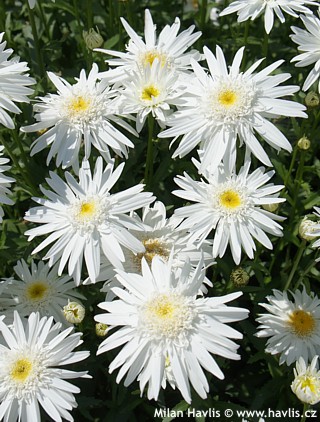
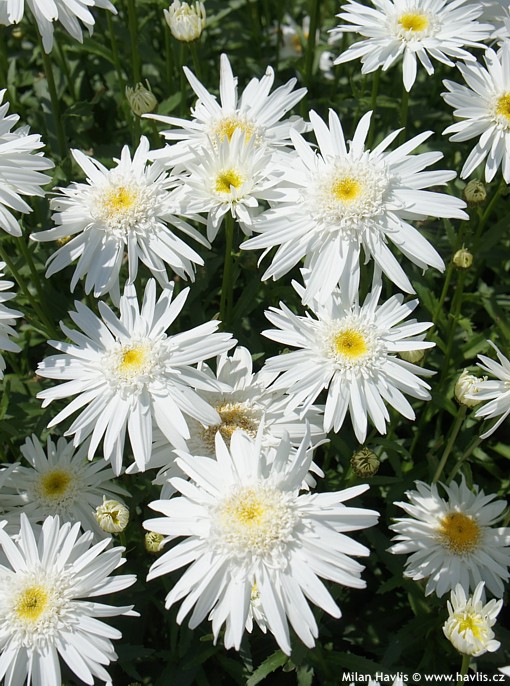
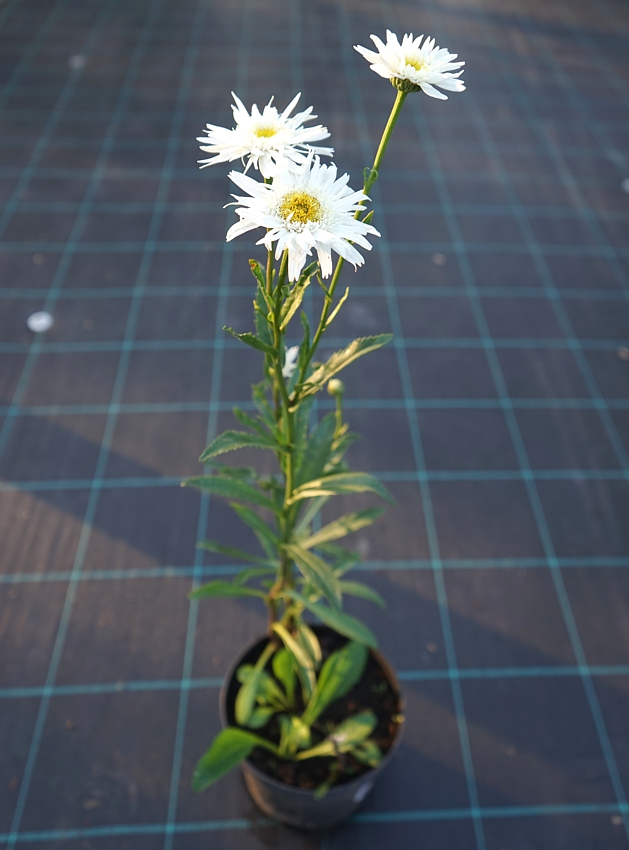
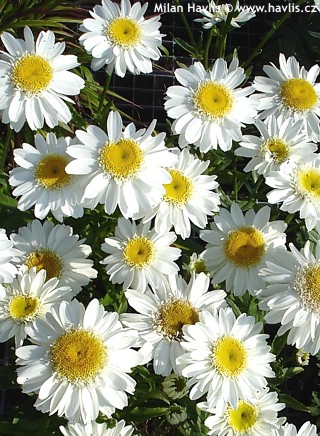
Wirral Supreme is a magnificent double-flowered Shasta daisy capable of impressing even gardeners who normally give herbaceous perennials little attention. Its blooms are exceptionally full, although botanically they are considered semi-double, and their snow-white appearance recalls garden chrysanthemums more readily than traditional daisies. The flower heads can reach around 10 cm across, with the central disc largely obscured by numerous shortened white petaloids, leaving only a small glimpse of the yellow centre visible at peak flowering. Worth mentioning is the distinctive fragrance shared by many daisies, a blend of herbal notes and something deeper, difficult to define, yet familiar from plants such as chamomile, mayweed and cotton lavender.
The plant forms strong upright stems approximately 60 to 90 cm tall, emerging from a dense clump of dark green, glossy foliage. Compared with the original single-flowered Shasta daisies, it appears considerably more refined and theatrical, while still retaining the natural character that makes daisies so appealing. Known for many decades, it remains one of the most highly regarded double-flowered Shasta daisies ever introduced. Its exceptionally large blooms, reliability and longevity in the garden earned it lasting popularity among gardeners as well as the prestigious RHS Award of Garden Merit in 1993. The origin of the cultivar itself is not reliably documented, but the name suggests a connection with the Wirral Peninsula in north-west England, making it tempting to imagine that its birthplace lies somewhere in this corner of Britain, a country with a long and passionate tradition of perennial gardening.
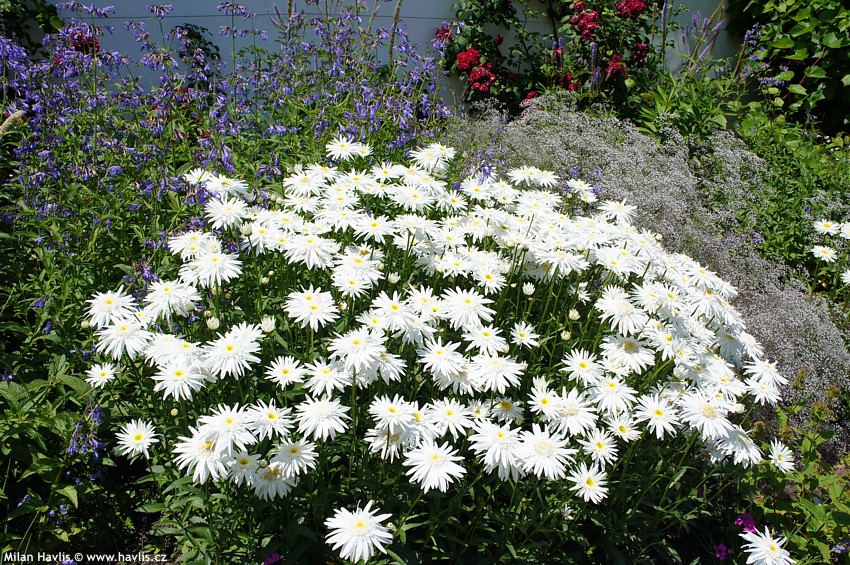
Without showing any bias towards cottage-garden perennials, I would happily place daisies among the most beautiful and versatile herbaceous plants available. They can be used in almost any perennial planting scheme. Low and compact cultivars shine along path edges, at the front of borders, in smaller gardens and even in large containers, where their pure white flowers appear as natural as daisies and dandelions scattered across a summer meadow. Taller cultivars and classic Shasta daisies belong in the middle or rear of perennial borders, where they create broad sweeps of white visible from considerable distance throughout summer. Whether you choose to give them centre stage in generous drifts or use them sparingly to punctuate a more naturalistic meadow-inspired planting is entirely up to you. They combine beautifully with Echinacea, Salvia, Nepeta, Achillea, Perovskia, Veronica and Hylotelephium, their simple flowers providing a calm counterpoint to bolder colours and stronger architectural forms. Thanks to their sturdy stems and excellent vase life, many cultivars also make outstanding cut flowers, allowing a portion of the summer border to find its way indoors without noticeably diminishing the display outside.
Last update 19-07-2012; 06-10-2026
Daisies ask for very little. They require plenty of sunshine and well-drained soil that does not remain dry for extended periods during summer. Similar conditions occur naturally in flower-rich meadows, where surrounding vegetation shades the soil surface and helps conserve moisture. They perform best in open, sunny positions and become sparse, less floriferous and less compact in shade. Ordinary garden soil is generally suitable, but prolonged winter wetness should be avoided. Removing spent flowers is not essential for the plant's health, yet regular deadheading promotes additional buds and extends the flowering season considerably. Many modern cultivars are also capable of producing a second flush of blooms if cut back down to the leaf rosette promptly after their main flowering period. Mature clumps benefit from division every few years, as the centre may gradually lose vigour. Container cultivation is most successful with compact selections, whereas taller cultivars usually perform best in open ground. Plants are rarely troubled by serious pests and are not considered allergenic or poisonous. Given sufficient sunlight they develop strong stems that most modern cultivars carry without staking. Hardiness varies slightly among cultivars, but many garden Shasta daisies tolerate temperatures of approximately -30 to -35 �C (USDA Zone 4).
Goods are shipped all over Europe. For Russia and U.K. and for further details please read about SHIPPING OPTIONS HERE.
Are you interested in a serious discount for orders NOV-FEB? Check your options here.
THE PRICES INCLUDE VAT of 15%. For quick conversion you can use 1 CZK = approx. 0.04 EUR
- STANDARD QUALITY - Plants of this group are 1st class quality with number of branches and overall density adequate to their size and age, considering they were container grown.
- DE LUXE QUALITY - This label guarantees a luxurious quality of manually selected plants that, compared to their height and age, are exceptionally dense and beautiful.
- EXTRA - These plants are usually mature and bigger specimens with exceptional overall appearance.
- STANDARD (as described in the plant form) means a tree with a trunk of 190-210 cm and a crown at the top, unless specified differently. The commercial size for trees is their girth measured in the height of 1m from ground.
- HOBBY - These plants are of the same quality as our standard-quality plants but younger and therefore cheaper.
- SHRUB - a woody plant with branches growing bushy from the ground level.
- HALF-STANDARD or MINI-STANDARD - a small tree with shorter trunk, its size is usually specified.
- FEATHERED - These are trees with branches growing already from the base of the trunk and up along the stem.
- GRASSES and PERENNIALS - Sizes given usually read the diameter of the pot or the clump, as specified.
