












.jpg)
.jpg)
Persicaria amplexicaulis 'AMETHYST SUMMER' clasping knotweed

 Symbivit Tric (arbuscular)
 Symbivit (arbuscular)
Persicaria
The genus Persicaria is a broad group comprising approximately 132 species, most of which are perennials, though annual herbs, several subshrubs and even climbing forms also occur. It is distributed across almost all continents, so every part of the world has its characteristic knotweed: in Europe the best known is Persicaria bistorta, while in gardens the most commonly grown species originate from Asia. The genus belongs to the knotweed family, which appears in Tertiary fossil records, and its taxonomy was long unsettled: botanists alternately merged it with the broadly defined genus Polygonum or separated it according to leaf and inflorescence morphology. The first systematic descriptions were published by Carl Linnaeus (1707�1778), but the true delimitation of the genus was established only in the twentieth century through anatomical and later molecular studies. Interestingly, some species were once considered weedy, whereas others have become icons of modern garden design thanks to their ability to flower for most of the summer.
Persicaria amplexicaulis, the clasping knotweed, originates from moist montane regions of the Himalayas, where its natural range extends from Afghanistan through Pakistan and Nepal to central and south‑eastern China. The species was described by the Scottish botanist David Don (1799�1841) in 1825, based on Nepalese collections that at the time represented one of the most valuable botanical sources in Asia. Several decades later it was studied by George Bentham (1800�1884), whose work helped to clarify the species and place it within the wider context of the knotweed group. The clasping knotweed reached European gardens very soon after its botanical description: by 1826 it was already present in British gardens, where it became popular for its exceptionally long flowering period and its ability to create a soft, mobile rhythm in perennial plantings, produced by the combination of slender inflorescences and large, flexible leaves reminiscent of waves on the sea. The first records from the wild in Britain date to around 1908, showing that the species gradually spread beyond cultivated areas. In subsequent decades it became established throughout Europe and is now a common component of modern naturalistic plantings. The striking way in which the leaves clasp the stems gave rise to the species name and creates an ornamental detail that feels both exotic and familiar in the garden.
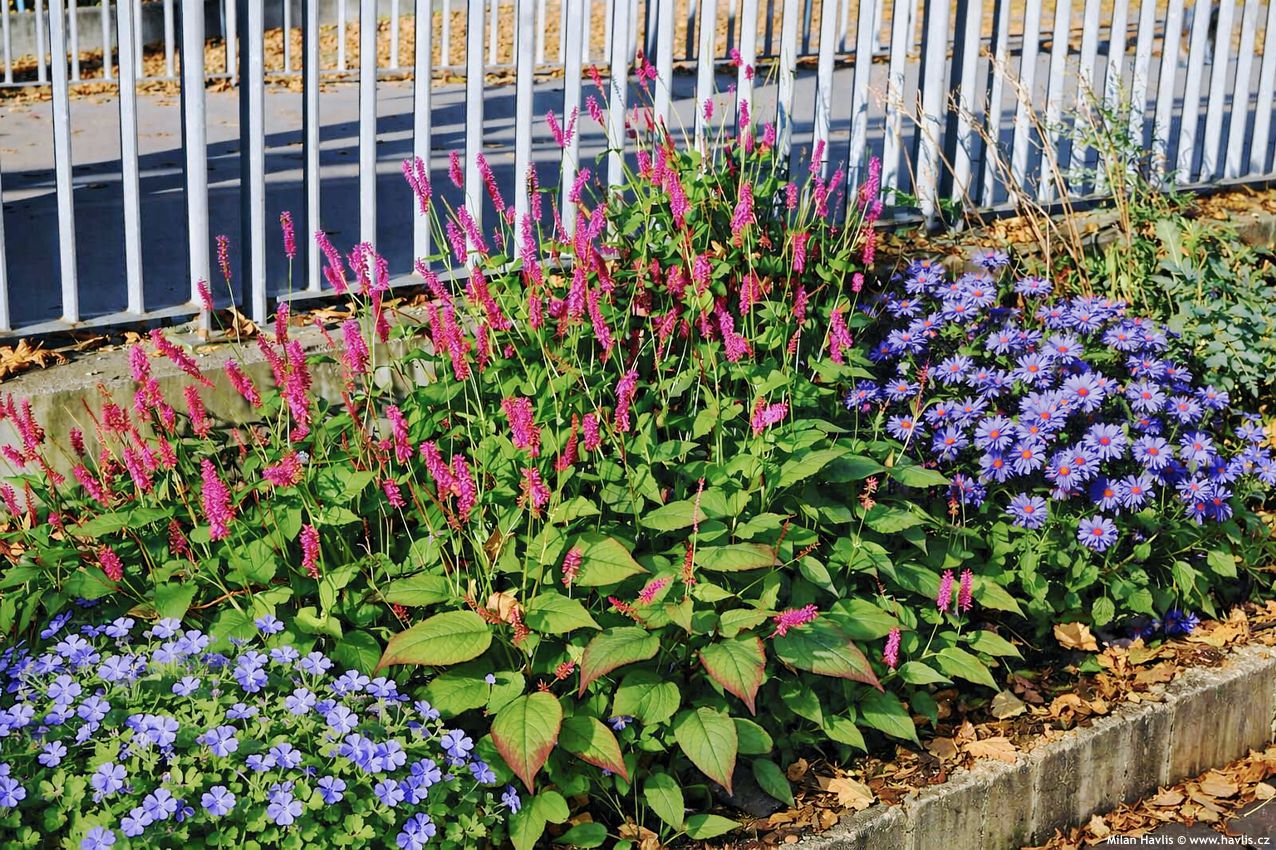
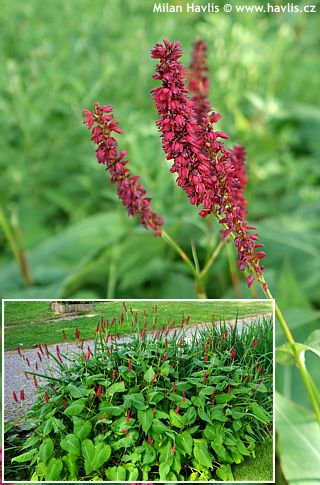
Amethyst Summer is a remarkable cultivar of clasping knotweed, selected by the Belgian plantsman Chris Ghyselen, who traditionally releases his selections through the Dutch nursery De Hessenhof. The cultivar stands out for its unusually intense flower colour: instead of the usual pink or red typical of clasping knotweed, it bears spikes in shades of raspberry�amethyst with a violet undertone, recalling in late summer the vivid cyclamen‑purple of Geranium psilostemon. The plant forms firm, medium‑tall clumps that appear stately but never heavy; the leaves are large, soft and dark green, with the uppermost ones always showing a reddish‑purple flush that adds an appealing contrast and invites imaginative combinations. The inflorescences are narrow, about 10�12 cm long, densely packed with small flowers that open gradually from the base upwards, so the plant flowers continuously from July to October. Compared with the botanical species, Amethyst Summer is more intensely coloured, more compact and visually softer.
Chris Ghyselen has long focused on selecting perennials for naturalistic plantings, especially species with fine structure and a long season, such as knotweeds, geraniums, burnets and grasses, which introduce attractive movement into the garden. Amethyst Summer thrives precisely in this context: its exceptional raspberry to cyclamen‑crimson colour creates slender late‑summer beacons that combine beautifully with perennials in shades of pink, purple or warm red. It works superbly with Geranium psilostemon, and pairs equally well with burnets (Sanguisorba officinalis and S. �Tanna�), whose delicate flowerheads lend lightness to the planting. Among grasses, lower cultivars of Molinia caerulea are ideal, forming a translucent veil that allows the knotweed�s inflorescences to stand out. In partial shade, combinations with geraniums (Geranium �Rozanne�, G. �Patricia�) and with the fine late‑summer asters (Aster divaricatus, A. ageratoides) are particularly effective, extending the season into October. For a more exuberant display, rudbeckias or goldenrods can be added. Thanks to its compact habit and the absence of creeping rhizomes that make some knotweeds weedy, Amethyst Summer is suitable even for smaller gardens, where it can provide a striking colour accent.
Last update 02-07-2026
In terms of practical usefulness, clasping knotweed has one undeniable advantage over many summer perennials: it tolerates heavy, clayey and even occasionally waterlogged soil exceptionally well. Together with its high frost hardiness, these qualities have quickly made it one of the most frequently used perennials among garden designers who value reliability above all. The soil may be ordinary garden loam, moderately fertile or poorer, though ideally it should be moist, humus‑rich and friable. It is not demanding regarding pH: it tolerates neutral and slightly acidic soils, though strongly alkaline clays do not suit it. It may take a little longer to establish after planting, but once settled it grows beautifully and fills its space without becoming invasive: clasping knotweed forms clumps, produces no runners and does not spread into the surroundings. It may self‑seed occasionally, but never to a troublesome degree. It performs best in full sun to light partial shade; in partial shade it flowers slightly longer and the foliage remains fresher, while in full sun the inflorescences are more abundant, but the plant requires more moisture. It dislikes drought, and during hot, rainless summers it appreciates additional watering � the improvement in leaf vitality is almost immediate. It is fully hardy to at least �34 �C (USDA zone 4), so it overwinters without difficulty throughout central Europe.

.jpg)
