












Pyrus communis 'WILLIAMS' pear tree

 Symbivit Tric (arbuscular)
 Symbivit (arbuscular)
Pyrus
The genus Pyrus � the pear � is among the oldest fruit groups cultivated by humans, with a history stretching back thousands of years to the regions of the Caucasus, Asia Minor and Iran, from where pears spread into Europe and China. Wild species inhabit light woodlands, mountain slopes and dry rocky hillsides, and share several common traits � a deep root system, great longevity and the ability to produce firm, resilient wood. These characteristics are also reflected in Pyrus communis, which over centuries of domestication has been bred and selected into dozens of growth forms, from vigorous tall standards to modern dwarf types suitable for small gardens.
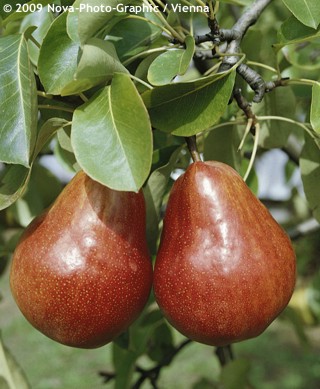
The history of red‑fleshed pears, however, is much more recent. While red‑fleshed apples have been known since the 19th century, pears with similar traits appeared only in modern times. In Germany, selections with strong anthocyanin pigmentation began to emerge, and for their unusual character they were grouped into the Vampira series � a collection of fruit trees with red flesh.
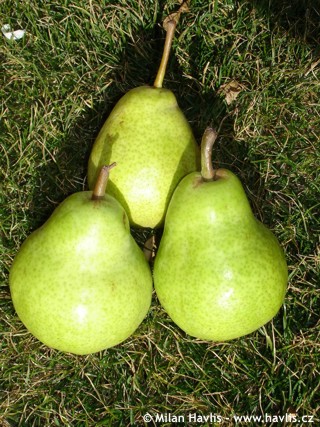
Williams is probably the most known and spread out pear in the world. Its complete name is Williams bon Chretien and comes from the UK, 18th century.
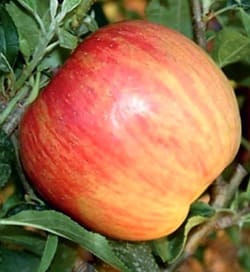
It is an early variety bearing mid-sized or large fruit with light green or yellow skin. The flesh is very juicy, aromatic, and sweet, it quickly softens when picked, therefore it is not suitable for storing. It tastes best freshly picked up from the tree.
It is partially self-fertile but crops best with a good pollinator, such as later variety Conference.
It forms a mid-sized tree with wide crown. Pest and disease-free. Pears are not picky about soil type if the place is not damp or filled with stones. Adding of good compost will help increase crop and the tree will get stronger sooner. Make sure to stake young plants. Fully hardy, it tolerates northern exposures and wind if it gets enough sun.
Last update 16-09-2008
Pears are not demanding to grow. They thrive best in full sun but will tolerate partial shade. The soil should be loamy to sandy‑loam, well‑drained yet moderately moist, with a pH from slightly acidic to neutral. In the first years after planting, young trees should be tied to a stake, and high‑stem forms secured with a strong windbreak support, to ensure a straight trunk and stable root system. Fertilization is possible, preferably organic but not needed, and pruning is not required either � only a gentle thinning of the crown at the end of winter, more for aesthetics than necessity. The tree is hardy to at least �34 �C (USDA zone 4) and requires no winter protection.

Goods are shipped all over Europe. For Russia and U.K. and for further details please read about SHIPPING OPTIONS HERE.
Are you interested in a serious discount for orders NOV-FEB? Check your options here.
THE PRICES INCLUDE VAT of 15%. For quick conversion you can use 1 CZK = approx. 0.04 EUR
- STANDARD QUALITY - Plants of this group are 1st class quality with number of branches and overall density adequate to their size and age, considering they were container grown.
- DE LUXE QUALITY - This label guarantees a luxurious quality of manually selected plants that, compared to their height and age, are exceptionally dense and beautiful.
- EXTRA - These plants are usually mature and bigger specimens with exceptional overall appearance.
- STANDARD (as described in the plant form) means a tree with a trunk of 190-210 cm and a crown at the top, unless specified differently. The commercial size for trees is their girth measured in the height of 1m from ground.
- HOBBY - These plants are of the same quality as our standard-quality plants but younger and therefore cheaper.
- SHRUB - a woody plant with branches growing bushy from the ground level.
- HALF-STANDARD or MINI-STANDARD - a small tree with shorter trunk, its size is usually specified.
- FEATHERED - These are trees with branches growing already from the base of the trunk and up along the stem.
- GRASSES and PERENNIALS - Sizes given usually read the diameter of the pot or the clump, as specified.
