











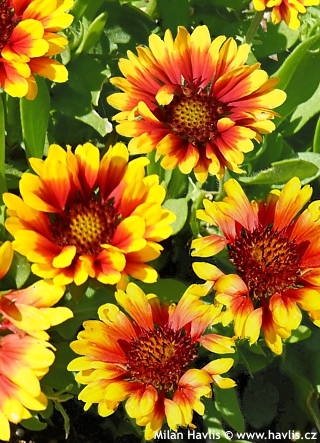
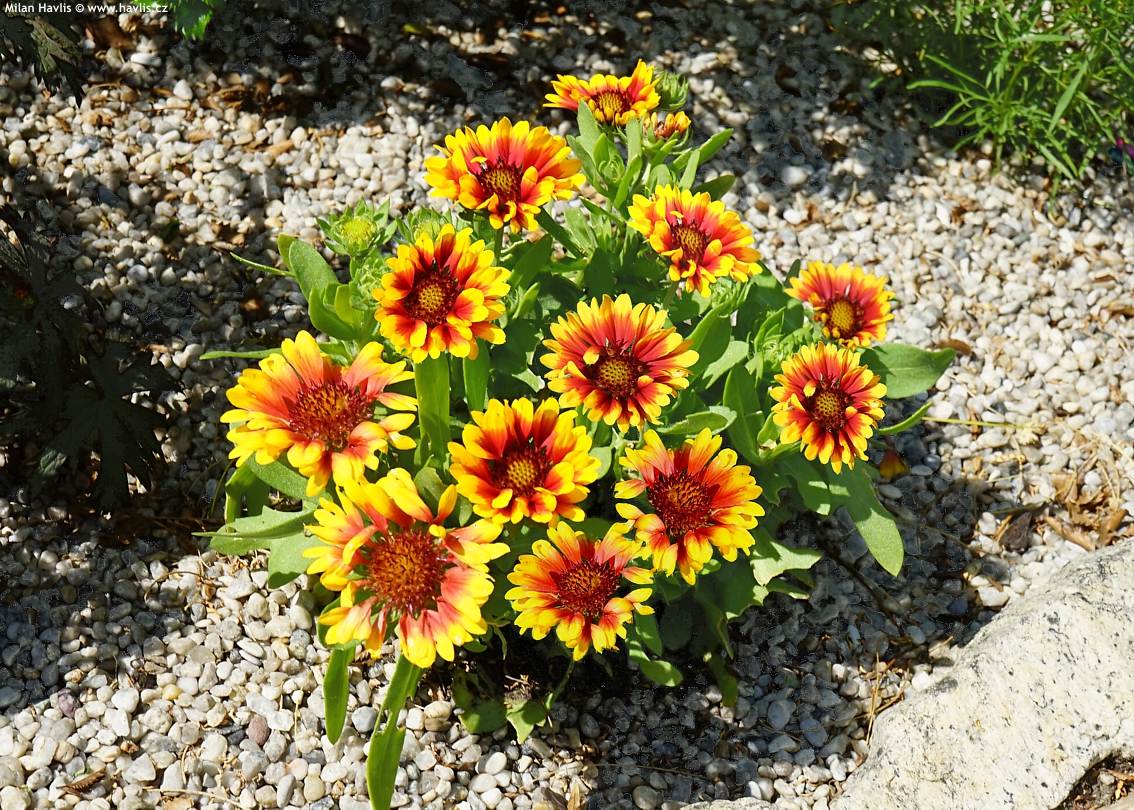
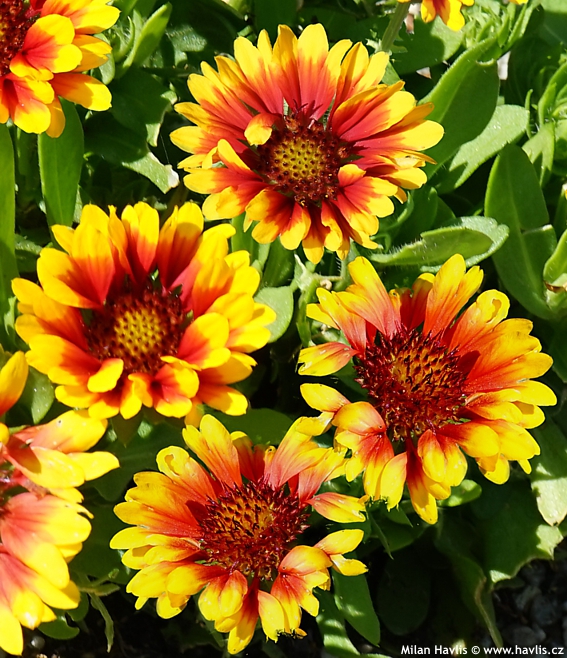
Gaillardia aristata 'SpinTop STARBURST' blanket flower

 Symbivit Tric (arbuscular)
 Symbivit (arbuscular)
Gaillardia
The genus Gaillardia belongs to the daisy family and comprises roughly a dozen species distributed from Canada to northern Mexico, landscapes where scorching summers alternate with cool nights and where plants have had to learn to survive wind, drought and fire. The first botanical descriptions date back to 18th and the genus is named after the French patron of botany Antoine Ren� Gaillard de Charentonneau (1720�1799), who supported Parisian naturalists at a time when North America was becoming a new botanical Eldorado. Blanket flowers reached European gardens quickly thanks to their tireless willingness to bloom and their colours, which during the Victorian fascination with exotic plants looked like small suns carried from the fires of the prairie. Interestingly, some late Pleistocene fossil finds suggest that the ancestors of today�s blanket flowers also grew in cooler regions, which helps explain their surprising hardiness despite their warm looking appearance. Within the genus there is a degree of nomenclatural confusion between G. aristata and G. pulchella, as they hybridise readily and form transitional populations in the wild that botanists have renamed several times. Yet this very variability underpins the richness of today�s cultivars, which differ in colour, height and flowering period.
Gaillardia aristata, blanket flower, is native to the Great Plains and the foothills of the Rocky Mountains, with a range extending from Canada to northern Mexico. The first collections date from the early 19th century in connection with the exploration of North America and the species was described botanically by Frederick Pursh (1774�1820) based on material that included specimens gathered during the expedition of Meriwether Lewis (1774�1809) and William Clark (1770�1838). In the indigenous cultures of North America, the blanket flower had both practical and symbolic uses: various tribes employed it medicinally for fevers, headaches and respiratory ailments, and the seeds were sometimes roasted and used as a food source. Thanks to its striking beauty the plant also appears in traditional decorative art and ritual motifs, where it often symbolises the sun and protection. It entered European gardens in the nineteenth century for its vivid colours and its ability to brighten borders for a long season. Today, in addition to its ornamental value, it is used in prairie restoration projects and for stabilising dry slopes, and it is valued for attracting pollinators.
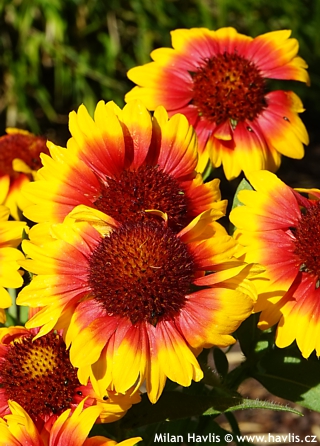
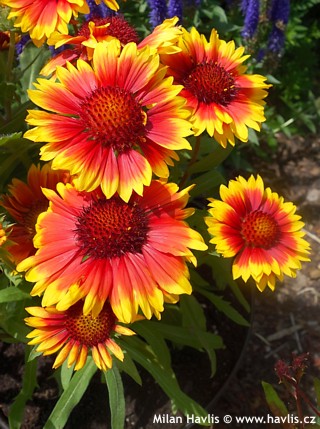
SpinTop Starburst is a work of art, indeed. Its colour combination may sound boring as red and yellow has been here so many times but you have to see the flowers. Their ray florets are produced in two rows and the flowers are large and often a bit ajar so yellow colour prevails. Moreover, they are always firm at tops of stronger stems, and look like a beautiful bouquet of freshly cut flowers. The centres are yellow with red corolla when young, and mature to dark, almost wine red. Blooming usually begins in mid June and continues restlessly until October, sometimes even November if early autumn is sunny and warm. The stems are hairy and short which helps maintain a compact, mounding habit and form a dense, extremely free flowering cushion. The plant can triple its size within one growing season. Deciduous, somewhat hairy leaves are pale green.
SpinTop is a new blanket flower series from Dutch company D�mmen Orange� introduced to market after 2015.
Last update 18-08-2020
Blanket flowers love full sun and well drained, rather poor soil where its roots do not remain wet for long periods. For a compact appearance it is useful to remove spent stems so that it produces new buds more quickly, although this is not essential as blanket flowers bloom generously even without deadheading, only taking a little longer to form the next flush. As typical prairie perennials they are more drought-loving and in heavy, water-retentive soils they may grow during the season but often rot in winter long before frost could harm them. In well drained soils, rock gardens or gravel plantings and without overfeeding, Gaillardia aristata tolerates frost down to around minus 40 �C (USDA zone 3), which reflects its natural hardiness in the North American prairies, and it persists on site far longer than encyclopedias suggest when they classify it as a short-lived perennial. Heavy feeding, on the other hand, often exhausts the plant in the first year, encourages excessive leafy growth at the expense of flowers and leads to early decline. The blanket flower is happiest where the soil is poor, the sun is strong and the care is light.