The genus Liriope is not only small but also relatively little known. It comprises roughly six species distributed across eastern and south‑eastern Asia, where they form a characteristic part of woodland understorey from the subtropical regions of China to the temperate zones of Japan and Korea. It was described botanically by Andr� Michaux (1746�1802) at the end of the 18th century, but its taxonomic history is full of reshuffling: for a long time it overlapped with the genus Ophiopogon, as both share similar ecological strategies and growth forms, and it was only Liberty Hyde Bailey (1858�1954) who finally stabilised it in 1929 as the Liriope we recognise today. Historical sources show that Liriope had been cultivated in Asia long before its formal botanical description � as a plant used to unify the edges of paths, fill empty spaces between shrubs and help hold soil on slopes, because some species of Liriope produce rhizomes capable of forming extensive colonies and thus act as a natural lock against erosion. Europe has known the genus only since the twentieth century, thanks to Bailey, and its early use was limited to a low, evergreen alternative to ornamental grasses.
Liriope muscari, lily-turf, was described by Joseph Decaisne (1807�1882) in 1867 under the name Ophiopogon muscari, and it took more than sixty years before Liberty Hyde Bailey transferred it to Liriope. Decaisne did nothing wrong at the time � the boundaries between Ophiopogon and Liriope were unclear in the mid‑19th century and the two genera shared almost identical morphological features. Decaisne was also one of the leading authorities of his era: he headed the Jardin des Plantes in Paris, then the most important botanical institution in the world, where collections from across the known world were gathered, research was carried out, herbarium material exchanged and new species described. His work covered plant systematics, anatomy and physiology and was valued for its precision, so it is no surprise that Bailey relied on Decaisne�s herbarium material when reassigning the species. The plant originates from south‑eastern China, Taiwan, Japan and Korea, where it grows in forested valleys, along the edges of bamboo groves and in places traditionally used by people. Its specific epithet refers to the grape hyacinth, Muscari armeniacum, familiar as an inseparable part of spring bulb borders, as the spike‑like inflorescences are quite similar. Modern horticulture values the plant for both its evergreen foliage and flowering, and probably most importantly for its overall ease of cultivation.
Description of the plant
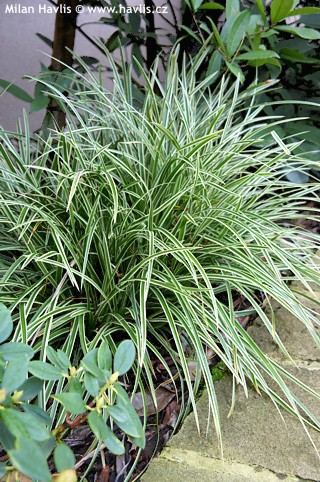
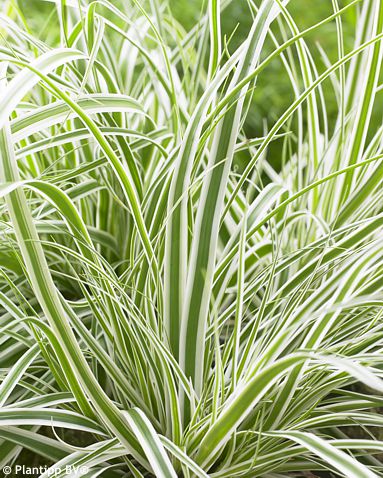
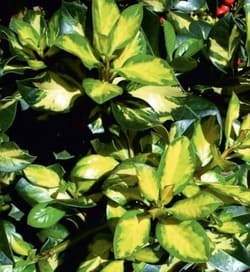
Variegata is an attractive version of lilyturf. It has ribbon-like, semi-glossy foliage that is deep green in the centre and rich creamy yellow at the edges. The leaves are evergreen in mild winters. In midsummer spikes of lavender or violet flowers come out and usually do not overgrow the leaves. New spikes are produced continuously until early autumn.
Last update 12-10-2010
Growing conditions and care
Liriope muscari prefers partial shade to full shade and is highly tolerant of drought. It will be more lush in soil that can hold some moisture without staying waterlogged, though ordinary garden soil with a touch of humus is perfectly sufficient. We�ve found that it grows slightly better in acidic soils, with deeper green foliage, but it isn�t essential � it will manage almost anywhere, only perhaps a little slower. Its strong drought tolerance has become especially evident in recent decades, as rainfall decreases and older perennial species begin to show that the new conditions don�t suit them. Liriope copes well even in drier spots under the trees and between their roots, and in urban beds without irrigation, relying solely on whatever rain arrives. Conversely, if you water regularly or have irrigation, you can grow it in full sun. It doesn�t require feeding, but it responds quickly to nutrients with stronger foliage and more generous flowering. The leaves are left on through winter, though if they look tired and untidy by spring, they can be cut back to about 5 cm above the ground. This isn�t needed every year � once every few seasons is enough. Its hardiness reaches �29 �C (USDA zone 5), so in Central Europe it usually needs no winter protection, except for a light mulch in its first year. It can also be grown in outdoor containers with excellent drainage.
Watchdog
We don't have this item at the moment, but I'm a watchdog and I'll keep an eye out for when it's back, do you want it? Enter your email, copy the code from the picture and send :-)
By pressing the �I Agree� button, you agree that we will provide you with meaningful and useful services based on your web browsing tracking data.
Of course, you can change your consent at any time in the �Settings� section.
Settings
I agree
Cookie settings
You can choose how your personal data is used.
Technical Cookies
The use of cookies ensures that this website remains functional and usable with all content. In addition, this will allow us to ensure the most comprehensive measurement and evaluation of the range.
I agree
Better service offerings
The use of cookies allows us to optimize this website for your needs. Based on the measured data, we will know what we can improve and ensure that we continuously adapt our services and offers for the best possible experience.















 Symbivit Tric (arbuscular)
 Symbivit (arbuscular)